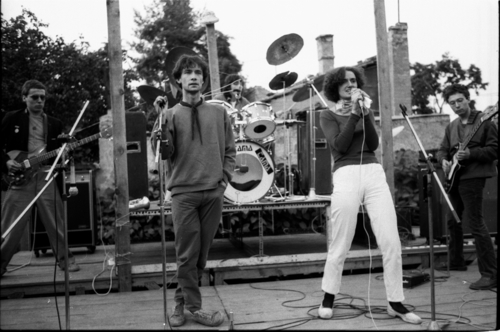
Masters Of World Jazz – a very special performance!

Yvette Perez is a new york based vocalist, songwriter, keyboard player, and bandleader of two avant-pop groups h*e*r and birdbrain. Her work is influenced by the effects of everyday industrial environments on personal psychology, women, and ambiguous identity. the milieu of oppressive crowded freeways, burning refinery flames, and car dealerships in the restricted home environment of an obsessive, agoraphobic single-mother of her Southern California childhood permeates the stories in songs about the mysteries of housework and nature. This tradition continues as the overbearing brooklyn-queens expressway dominates the view and soundscape of her apartment in Brooklyn, NY.
Yvette studied jazz and avant musics at smith college with Yusef Lateef and Roger Reynolds while playing in local, western massachusetts rock bands.
1. Copresented by Asia Society and the Global Film Initiative
October/November 2009
All screenings at Asia Society, 725 Park Avenue at 70th Street, NYC
See discount code below!
Focusing on lives of women in contemporary Iran, this mini-film series presents portraits of strong women negotiating their space and freedom in a narrow world of strict social conventions.
For more information, visit Asia Society
By John Kruth
“People were playing shells before there was written language. It goes way back to ancient times. It’s the roots of brass!” Steve Turre exclaimed. “Nobody knows what it sounded like. There’s no written notation or recordings available. The Spanish conquistadors destroyed the culture so we can only guess.”
Turre’s first exposure to the conch shell as a musical instrument came as a teenager
when he sat in with Rahsaan Roland Kirk and the Vibration Society at the Both/And Club in San Francisco. Kirk, a master multi-instrumentalist, was famous for playing three saxophones simultaneously, along with flute, clarinet, and whatever else he could get his hands on. At any given time during a gig, Rahsaan’s music could abruptly spiral into a wild free-for-all, where anything could and did happen.
“He’d blow the shell and then hit the gong,” Turre recalled with a big grin. “The sound of the shell did something to me. It made me tingle.”
Paley Docfest, NYC, NY
October 21, 6:30 PM
25 West 52 Street Map
Q and A with the filmmakers and Marjaneh Halati
Date: Saturday, October 10, 2009
Time: 8:00pm – 11:00pm
Location: Miller Theater of Columbia University
Street: 2960 Broadway – Columbia University
Description of the event:
The Iranian American Society of New York is presenting two exclusive performances moderated by Dr. Lloyd Miller:
Kato-bushi is a style of Japanese traditional narrative music, called Joruri, accompanied by the shamisen, which is three-stringed banjo-like lute. It was created in 1717 by Masumi Kato (1684-1725) of Tokyo, which was called Edo at that time. He first studied Handaya-bushi, an earlier style of Joruri, under its originator Handaya Edo (who died around 1743).
Because of its stylish, sophisticated and delicate melodies of pure Edo origin, Kato-bushi was favored by intellectuals, the wealthy, as well as some government officials and their samurais of the Edo period. Competing with other Joruri styles of that time, Kato-bushi flourished in Edo and influenced other music styles of that time.